Read a PDF file of the article will all photographs
This article appeared in The Lookout Network Vol 22 No 2 Summer 2011
Three towers, Norway, Sioux River and Angleworm, graced lookouts in the western part of the present Boundary Waters Canoe Area Wilderness near Ely, Minnesota.
Rangers hewed a trail in the wilderness around 1910 to provided access and a telephone service to Ranger Stations stretching Northwest of Ely. The trail eventually became a 45 mile roller coaster road of gravel and rock in the 1920's. Gradually highway engineers straightened and paved portions. However, much of the Echo Trail retains its twisty, unplanned look.

Cab of the Sioux River Lookout Tower
September 2009
I drove the Echo Trail with my brother to visit these three wilderness tower lookouts during the summer of 2009.
After a 7 mile drive south down a minimally maintained forest road from the Echo Trail, I hiked 1 mile into the wilderness to the site of the former Norway tower. The trail has the characteristics of the Civilian Conservation Corps (CCC) built trails: rock curbing which strengthens the tread and neat flat rock bridges over low spots.
Before my hikes, I set waypoints for the tower locations on my GPSr unit. The forest has reclaimed the spurs to the Norway and Sioux River tower sites. Finding the towers requires GPS guided bushwhacking. The waypoint at Norway guided me over a tangle of windfalls, hazel and brambles. However, when leaving the site, I noticed orange plastic tape which marked the track of the former access trail. Perhaps the Forest Service anticipates clearing the old trail.
These three wilderness towers keep many secrets: age for example . My research to date tells me that Sioux River is the oldest. The forest service used this lookout and had some structure built before the CCC era (1933-1942).
The Forest Service instructed new Rangers, or Guards as they were called, to use high points to scan for smoke. In some cases they climbed a tall pine or built wooden structures to get a better view. A strong push for towers on lookouts with telephone communication began in 1910-11. Before then a fire report to Ely might require days or a week or more depending how quickly a ranger could hike or paddle back to headquarters.
Ely, Minnesota and the Western United States experienced drought in 1908, 1909 and 1910. Just 1 month into the summer of 1910, Minnesota already reported 189 fires . Many burned around Ely and threatened the town. A new forest supervisor in Ely, Joe Fitzwater, announced an aggressive goal, "As fast as appropriations allow, trails together with telephone lines, will be built through the more inaccessible districts."
To demonstrate his resolve, in early spring United States Forest Service (USFS) Supervisor Fitzwater dispatched a crew of 6 up the Kawashiwi River east of Ely. On a high rock outcropping at a bend in the river they constructed, a 50 foot lookout tower by attaching poles and a platform to a large pine tree. The Rangers cut a trail with telephone to connect with Ely Headquarters. Ole Fernlund and John Handberg, two crew members, contributed their names to the title of the new tower: Fernberg.
During that same time another crew built a station on the Echo River some 50 miles northwest of Ely. By 1920 the Forest Service had built 5 Ranger Stations along the Echo Trail.
The towers proved successful. In 1920 the Minnesota Forest Service (MFS) reported they had placed the final equipment in the Jasper Peak tower. Already the tower had more than earned back the initial investment for its construction through lessening the cost of firefighting.
'As funds permitted'… I can imagine another crew paddling the Little Indian Sioux River and choosing a tall pine on the high ridge above the Devil's Cascade some 8 miles off the Echo Trail. A December 1920 issue of the outdoor magazine, Outing, notes the existence of the Sioux River Tower in an article titled "A Canoe Fire Department" .
In 1910 the Forest Service required: 'every patrolman and ranger, in his early trips through the territory assigned to him' should search 'for points where lookout stations would be of value.'
Eventually among the many possible lookouts, the forest services selected those which fit the pattern needed to see smoke and provide triangulation to locate fires. In some cases, Sioux River for example, the lookout guard would hike the telephone line trail many miles or, perhaps, paddle and portage a canoe that far.
The Minnesota Forester reported: " in 1911 the money spent build: 92 wooden towers, 13 steel towers and 8 cabins for a total cost of $3587.52."
I hiked 6 miles into the Sioux River Lookout. Ambitious tourists use this trail to visit the Devil's Cascade along the Little Indian Sioux River. Wilderness hikers use it as the first leg of the 35 mile Sioux Hustler Trail. The huge bald rock outcropping is the most spectacular of the three towers. The lookout guard occupied a cabin about 1 mile away perched above the canyon of the Devil's Cascade.
The USFS and MSF scattered small ranger cabins throughout forest. District rangers lived permanently in some of these cabins. Other cabins served as temporary headquarters for rangers working in the area and as caches for firefighting supplies. If necessary, a fire fighting operation might headquarter in such a cabin. Also the forest services placed cylindrical steel chests on prominent rocks throughout the forest filled with fire fighting tools.
A network of telephone lines strung along forest trails connected these remote wilderness cabins and fire lookouts to each other and to headquarters.

Sioux River Tower Guard Cabin Aug 1932
How would you build such a telephone line? First clear a trail. Next string a single strand of No. 9 GI (galvanized iron) wire through an 8 mile series of split ring insulators attached to trees. The split ring insulators allow some play in the line. This slack will often prevent a fallen tree from snapping the line. In areas void of trees due to past fires, barren rock other reasons cut a tree, drag it in a erect it, an 'artificial' telephone pole, supported by a cairn of rock. Make sure to mount the wire high enough to avoid entangling the antlers of a bull moose, but low enough that the ranger who must regularly patrol the line can reach to repair it. Also install regular lightening grounders minimize damage from lightening strikes during storms.
Angleworm tower and its tiny cabin formed part of the "Canoe Fire Department". A 2 ½ mile hike off the Echo Trail brought me to the site of the former tower.

Angleworm Tower Guard Cabin Aug 1928
By the early 1920 a spur of the Swallow Hopkins logging railroad reached the eastern shore of Angleworm which could provide easy access to the site of the Angleworm Tower on the western shore. The USFS used a small gasoline powered speeder to facilitate access to the tower until 1937 when the logging company pulled the rails.
How much longer the USFS used this right-of-way or when they built the present 2 ½ mile trail from the Echo Trail to the tower is unclear. (However, the current trail does not show the markings of CCC work.)
I found pieces of the entire tower structure deposited a few hundred yards in the brush, over the brow of the hill. It appears that once toppled (with explosives), the crew disassembled the structure into pieces a man could carry.
We have the Canoe Fire Department in place. On the hike to Sioux River lookout I paused and imagined how the men and women in the USFS and MFS made this system work. So, as Donald Hough in his article The Canoe Fire Department suggests let's "have a fire, just to try the thing out."
A party of canoeists travels one of the many routes. They cook coffee and breakfast over a small camp fire one morning. The fire seems out especially after casting the dregs of the coffee pot over it. By day's end our party is many miles away and all seems well at their morning campsite. However a few hot embers remain in the thin duff. A wind freshens the second evening after their departure. The embers glow, a bit of flame erupts, spreads; the woods begin to burn. With nightfall the fire abates a little, but still slowly eats into the forest.
On the third morning our lookout guard at Sioux River walks the mile from his cabin at Devil's Cascade to the tower. He climbs the tower, scans the horizon but sees nothing. A stronger wind starts late morning. During a later sweep of the horizon with his glasses he sees smoke rising from trees on the mainland of Lac La Croix, a lake many miles to the north. He sights across his map and notes the compass reading. Climbing down the tower he opens a cast iron box, retrieves the telephone and rings Ely to report smoke at the compass reading of his sighting
Next, on the large map at headquarters in Ely, the supervisor takes a string attached to the Sioux River tower location on the map. Surrounding that spot, and the places of other tower locations, is a large circle inscribed with degrees of a compass. He stretches the string out from Sioux River to the compass degree reported by the lookout and fastens the end on the map with a thumbtack.
He then calls other towers that might see the smoke and asks them for readings as soon as they see smoke. Being at greater distances other towers might not see smoke until the fire has grown. Finally he gets more readings, tacks more strings to the map. The intersection of the strings pinpoints the location of the fire.
Now he calls the nearest district ranger give him the information and says a fire crew of 20 men will leave as soon as he recruits them. Men in town learn the forest supervisor needs a crew and enlist. From the warehouse, he pulls canoes from storage and gathers the packsacks and boxes with supplies. The Minnesota Forest Service supervisor in Tower, a town close to Ely, often sent along a crate of homing pigeons with the crews . The fire crews could then send emergency messages back to headquarters.
After enough men assemble, they mount a truck with their supplies for a short to ride to the water route which they will follow to the fire. (These early crews used water travel. In those days road travel for any distance around Ely followed tote roads and required the extensive use of a shovel and axe.) These fire fighters must paddle through lakes, channels, around rapids, walk long and short portages. They may arrive at the fire site that evening or the next day to begin fighting the fire.
The Sioux Tower guard and those of other towers continue monitoring the smoke. When the smoke continues for several days, the supervisor will dispatch more supplies by canoe. When smoke increases indicating an intensifying fire, or the smoke plume moves from a traveling fire, the supervisor recruits, outfitts and sends more crews to the fire.
Extensive use of airplanes in spotting fires would not begin until the late 1940s - after the Second World War. When planes began to replace towers, trails and canoes, our three towers retired. Wilderness legislation in the 1964 required removal of man-made structures throughout the wilderness. Crews toppled the towers from their heights.
Sometime in the late 60's' or 70's the USFS brought down the Sioux River tower and her two sisters. They placed them out of sight to rest in the wilderness forest the towers guarded for half a century.
Towers: North: Sioux River (N48° 12' 29.5" W092° 14' 33.5"),
West: Norway (N48° 02' 36.4" W092° 16' 18.6"),
East: Angleworm (N48° 05' 07.4" W091° 53' 32.3").
The dark line is the US-Canadian Border
Straight-line distance from Norway to Angleworm approximately 16 miles
Wednesday, June 01, 2011
Three Wilderness Fire Towers
Wednesday, June 16, 2010
"Don't find fault, find a remedy"... quietly.
The sermon for the coming Sunday June 20, 2010 has moved from random thought to a stream of consciousness.
Mulling over the lessons for 6/20:
A bit different riff on 1 Kings 19 and Gospel Luke 8:26-39:
Retell the story of 1 Kings 17 - the "Sacrifice Duel" Elijah sets up with Baal's prophets. Retell this story well and you'll get the attention of the most jaded in the congregation. It ends, of course, with Elijah winning. With that particular ability to control the crowd that victors possess, Elijah orders the slaughter of the 450 prophets - out of 'zeal for the Lord'. Jezebel of the Baal faction responds, in kind, telling Elijah she's put out a contract on his life. At first Elijah seems surprised (that the Lord would let such a thing happen to him), Duh, and the flees in fear.
He arrives at the Lord's mountain where the Lord gives him a bit of a lesson. The Lord is NOT in the violent displays, but in the quiet and reflective. Its as if the Lord says, (Duh) Elijah, you didn't quite get it right. Go back and try again! You need a better 'working definition' of the Lord and the Lord's power.
---
In the Gospel we see a man shackled and bound (a bit of violence there) because of his being tossed about violently by demons (outer or inner). The towns folk can only respond with a bit more of violence - shackling him. Some key words echo here - the violence/troubles of Elijah and his fear so he must go away. Also fear of the towns folk (perhaps they worried that 100 pigs might be 'charged' for each healing) but I suspect they feared more of their own inner or social demons might be disturbed by Jesus). What a change that would demand! The possessed man - and his QUIET (the man sitting quietly at Jesus' feet) and because of FEAR (the towns folk) it is Jesus who must and does go away. Do we have too many troubles/too much on our plates hence too many fears, and too little quiet?
Or consider the fortune cookie advice I received this week: "Don't find fault, find a remedy"... quietly.
Thursday, April 08, 2010
St. Louis River Trail
Out for exercise? Then why drive to the Munger Trail in Carlton. Get off I35 in Cloquet and start your ride immediately. Take exit 349 at Scanlon. There you will find the beautiful new bike trail into Carlton. The Saint Louis River was completed late last Fall.
The Scanlon Park and Ride provides ample parking. The old Northern Pacific right-of-way makes a beautiful corridor to the Munger Trail access in Carlton. The trail has a remote feeling most of the way. In Carlton it safely guides you to the Munger Trail Access
From the 'Northern Pacific Junction' you can cycle north into Duluth or south to Barnum. You can also access the Alex Leveaux trail through Wrenshall and beyond.
Enjoy the Saint Louis River Trail.
The trail parallels the Saint Louis River which you never see during the Carlton to I 35 Segment! When the trail is extended to Scanlon, you will enjoy some fantastic views of the River. Phase two of construction will extend the Saint Louis River Trail into Scanlon.
The St. Louis River Trail follows a railroad spur built by the St. Paul & Duluth Railroad in 1878
The Northern Pacific Railroad started building westward from Carlton (then ca lled Northern Pacific Junction) on February 15, 1870 the same year the Lake Superior & Mississippi Railroad completed the link from St. Paul to Duluth on August 1, 1870.
The St. Paul & Duluth constructed the Knife Falls branch in 1879 north from the North Pacific Junction (later renamed Carlton) rail crossroads into Knife Falls (later named Cloquet) to service a new sawmill built in 1878.
Obstacles in the river south of Knife Falls prevented the easy log driving south of this point into Duluth.
With rail transportation established, the local lumber industry boomed.
In 1888, the Duluth & Winnipeg RR began building northwestward from Knife Falls / Cloquet along the St. Louis River. Traffic from this new line was routed into Duluth over this St. Paul & Duluth spur.
Later the Duluth & Winnipeg built tracks eastward out of Cloquet through Esko and into Duluth via the Becks Road corridor. This project left the railroad short of cash and open to takeover by James J. Hill.
Finally, in 1898, Mr. Hill and the Duluth & Winnipeg built a line parallel to this road bed out of Cloquet slightly to the West into Northern Pacific Junction/Carlton, through Wrenshall looping eventually into Superior Wisconsin. The Burlington, Northern & Santa Fe continue to use that trackage.
On June 15, 1900, the Norther n Pacific Railroad purchased the St. Paul & Duluth Rail which originally build this spur into Cloquet.
In addition to the St. Louis River, two logging railroads fed pine to the many lumber mills in Cloquet.
The Minnesota & North Wisconsin built west out of Scanlon beginning in 1899 as the Mitchel & McClure passing near Adolph, Wild Rice Lake, north of Duluth, to Alden Lake, Northwest of Knife River.
In 1904 low water levels in the St. Louis River during spring log drives spurred building of the Duluth & Northeastern Railroad out of Cloquet to Island Lake and later to Rush Lake, Harris Junction and Hornby, north of Two Harbors. The Saint Louis River and two logging railroads brought pine into Cloquet. The Northern Pacific Railroad, over this railroad grade, together with the Great Northern a few blocks to the west, hauled the lumber to market.
Saturday, March 13, 2010
A Way in the Wilderness

I have a wealth of material: Mary who anoints Jesus feet. John identifies hers as the sister of Lazarus whom Jesus has returned to his sisters from the dead. I can imagine the immense gratefulness in Mary’s heart.
Luke relates a similar story a woman anointing Jesus feet that he designates as a “woman of ill repute.” The other gospels tell of women anointing Jesus, but his head.
Of course, down though the ages much confusion reigns: Same woman? Different event? A respectable Friend of the Family? A woman of disgrace?
The disgraced woman spin from centuries with Old Men in charge? Might it be a different spin with Old Women retelling the story?
Anyhow who cares! Because of this ambiguity she is a story tellers delight. I will recast the story in a way which forces the listener to question their own judgment about this woman.
My reading during this portion of Lent is the biography of John Newton: slaver, captain of slave ships in the infamous Middle Passage, repentant, Evangelical Anglican preacher, spiritual guide to William Wilberforce who for twenty-six years led the fight in Parliament to abolish the slave trade. Wilberforce succeeded in 1803. John Newton advised Wilberforce to remain a politician in Parliament rather than study for the ministry, convincing him he would be more valuable to the cause of slavery’s abolition as a politician. In 1833, three days before Wilberforce died, Parliament passed the Slavery Abolition Act which abolished slavery in most of the British Empire. Some three decades before the United States!
I impishly delight in the juxtaposition: whore – politician whom we both praise for the great good they bring. I won't go there in the homily, however!
The collect prayer leads further: “God, you alone can bring can bring order to the unruly will and affections of sinners”
It seems to me that we often diminish the outrageous generous behavior of God who deals to so open-handedly with the Mary’s and John Newton's and pulls great good from the jaws of evil. We often say the sinner repented and God embraced them – but seems to me God embraces and then helps the person sort out the evil and good in a their life and most importantly how to respond. Then repentance become possible.
And the Hebrew Scriptures from Isaiah add a wealth of images: “Make a way in the sea, a path in the waters”; “do not remember former things, or consider the things of old.”, “Make river in the desert”, “give water in the wilderness” --- all descriptions of the results of a Mary or a John Newton.
Some of us clutch fast to our evils. Some we’ve done, some we only imagine we’ve done. Afraid to lay the mess into Another’s hands who can help us “bring order to our unruly wills and affections” Others have the eyes of our hearts so closed in denial to the major or petty evils of our lives because we dare not hope God can bring good from acknowledged evil.
Tuesday, March 02, 2010
Northeastern Minnesota Trails
Soon some of Minnesota's most beautiful hiking trails will join the North Country National Scenic Trail. This trail runs more than 4,600 miles from Crown Point in eastern New York to Lake Sakakawea in western North Dakota.
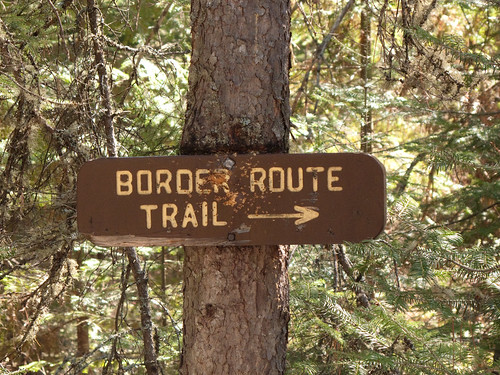
If legislation passes congress to reroute the trail, the Superior Hiking Trail, the Border Route Trail and the Kekekabic Trail all legendary will be incorporated into North Country National Scenic Trail.
The NCNST, longest of the 11 National Scenic Trails authorized by congress passes through seven staints. The National Park Service
I'm not of an age when I am likely to hike the entire 4600 miles, but I have hike portions of the Minnesota Arrowhead trails singled out for inclusion.
Inclusion would be a wonderful reward for the many volunteers who have planned, built and maintained these trails.
Sunday, February 21, 2010
To Dust We Shall Return
I was my time in the rotation to preach at St. Andrew's Episcopal Church in Cloquet this morning
A bit of graffiti under the Highway 33 Bridge sparked my meditation for Lent this year. Above and beneath the graphics the artist wrote: "Make a name; life is short!"
Someone young, I suspect, produced this piece of art. I doubt any of us older folk, sitting here this morning, go around town with a can of black spray paint doing art under bridges.
You can see this street art. You will find it on the way to the bar at the old Northeastern Hotel for a glass of beer or wine. By the way it's said the bar at the Northeastern has the longest bar in Northeastern Minnesota made  of one solid piece of wood. Of course, I cannot verify that since I have not visited all of the bars in Northeastern Minnesota. Yet! Also I believe the establishment a bit more positive cache than it once possessed.
"Make a name; life is short."
Lent speaks to this advice given in black spray paint.
A phrase from the Old Testament book of Genesis echoes over the beginning of Lent:
Sometimes the King James version seems to give these admonitions more heft:
Till you return to the ground,
For out of it you were taken;
For dust you are,
And to dust you shall return."
As the church imposes ashes on us at the beginning of Lent, we hear these words proclaimed to us: "You are dust and dust you shall return".
The natural question in every human heart: How do we rise above this dust?
"Make a name; life is short."
Rather than this message, Lent and Jesus would suggest something else.
"Make a friend life is short."
"For dust you are,
And to dust you shall return."
We hear this phrase of Genesis just after Adam and Eve have messed up. However, in the spirit of Jesus, I suggest this phrase is more than a condemnation of misdeeds or a warning against sin. We must always read Scripture in the spirit of Jesus: Heal the sick, feed the hungry, comfort the afflicted, visit the imprisoned, give drink to the thirsty and shelter the homeless.
"Make a name; life is short."
Rather Jesus would say: do good while you can, life is short. Our genes, I suspect, drive us look after ourselves and those who would cover our backs. However, the spirit of Jesus calls us look after others. Science tells us evolution programs a bit of altruism into to us to assure our survival. But the generosity to which Jesus calls us requires, as Genesis suggests, the "sweat of your face".
Just as we hear of Jesus in the Gospel lesson this morning, we must withdraw from the noise of our days and the anxiety of our lives and sit for a time in quiet and reflection. Goodness takes work, needs strength, demands courage, requires character. The call of Jesus does not automatically grace us with courage and character.
We can throw seed on ground and some will grow. But to feed our families and our poor neighbors we must till the soil to prepare it. We must pull the weeks, fend off insects, outfox the rabbits, water when dry, and carefully preserved the harvest for winter. Growth may be automatic; harvest requires sweat.
"Make a name; life is short."
Life is short! Fate limits our time for doing good, for comforting the weary, for feeding the hungry, for sheltering the homeless, for healing the sick, for reconciling the estranged, for visiting the isolated, for making peace.
"Make a name; life is short."
Perhaps someone young painted this phrase but what might this young person's parents have painted? Make a killing; life is short. Make money; life is short. Make a fortune; life is short. Guard your own; life is short. Or as bumper stickers once proclaimed: "He who dies with the most toys wins."
We do reach a point where we have enough. But amazingly we find it difficult to give away some of the rest. So from time to time we must review our character and strength so we can practice goodness. In this season of Lent, review your strength for doing good.
The gospel teaches Jesus went to the desert to wrestle with the temptation of greed and selfish. Yes, even Jesus battled acquisitiveness and the lust for power.
Build the pile; life is short.
The news, our radios, our television, our newspapers and magazines, have given us many examples of greed and the problems it causes. Our leaders seek to regulate our lust to accumulate with laws and regulations. Laws may lessen greed but law cannot assure generosity. Character and principle enable generosity. We must cultivate our character and nourish our principles. Do that this Lent!
Paul, a learned lawyer, knew laws can only make men and women honest; it cannot make them generous, kind, compassionate, in short good! Regulations can only control greed; they cannot force generosity.
St. Paul teaches us of this difference. He presents the image in his letters of a child who has not yet developed his character or strengthened the principles which will keep him from evil, from greed. During the time of his youth, a child is protected by parents, by guardians, by teachers. He is controlled by the law. When mature strength of character and the power principle develop, he is no longer under the law. He walks Jesus. This walking with Jesus, Paul calls Faith.
This Lent, renew and deepen your faith.
2 He is subject to guardians and trustees until the time by his father.
3 So also, when we were children, we were in slavery under the basic principles of the world.
4 But when the time had fully come, God sent his Son, born of a woman, born under law,
5 to redeem those under law, that we might receive the full rights of sons.
6 Because you are sons, God sent the Spirit of his Son into our hearts, the Spirit who calls out, "Abba, Father."
7 So you are no longer a slave, but a son; and since you are a son, God has made you also an heir.
We are heirs of God when we do the goodness of God. We are children of God when we display the compassion of God. We are daughters of God when we delight in feeding the hungry, healing the sick and comforting the afflicted. We are sons of God when we promote peace, give water to the thirsty, open doors to the blessings of our society for those we once shut out.
"Make a name; life is short."
"Do good; life is short."
Expressed more plainly, we rise above the dust not by building piles money or mounds of things, not by building piles but by bringing smiles to others.
"Remember that you are dust and to dust you shall return." The words call us not just to avoid evil but to turn toward good.
"Make a name; life short!"
Lent suggests requests and enables us to rewrite the graffiti under the bridge on our hearts: "do good; life is short!"
Saturday, February 20, 2010
On My Birthday
Each year as February 22 slips by and another of my birthdays, I whisper words of gratitude that my folks avoided naming me after George (or after Owen - my Grandfather).
I could live with the name of my other grandfather: Kasimir -> Charles -> Chuck.
Mr Washington would be 278 years old today. My age doesn't yet approach 3 digits. The most I gleaned from my parents about the origin of mya name, Kenneth, was, "a friend". Does that mean a friend named Ken or a friend suggested Ken? Oh yes, the name was voguish in '43. Or maybe the News Reels told of a war hero named Kenneth?
Well this Gaelic - Scottish - derived name means 'handsome' or 'born of fire' according to the experts.
Born of Fire: an early photo shows me in the arms of my sailor father, who is going off to war. Fits.
Handsome:
My folks got that correct!!
Alas, apart from the Ken of Ken & Barbie fame, I can't think of any 'Ken' Celebrities!
Monday, February 15, 2010
Bugs in the Woods

We spoke of wood ticks and deer fly. The ticks can be awful in the spring and June. The deer fly can make late June and July awful.
Deer fly tend to buzz about your head and bite your limbs inside the canoe. One of these gentlemen suggested: Place a band of fly strip around your head sticky side out. The flies which tend to bump into your head will hit the flypaper. The sticky goo will take them out of action.
The other gentleman said wood ticks climb upward as far they can get. Therefore you tend to find them stuck in armpits, your groin, your waist if you wear a tight belt or your hair. He recommended wearing Duct Tape. Place a piece of tape around your collar sticky side out. Make sure your clothes are tucked in well then you will conquer of the ticks.
Here we have two non-chemical ways to control North-wood bugs.
I've not tried them so you will have to take their word for it.
They offered no solution for black flies and knats!
Tuesday, February 09, 2010
Kowsit Lats
 I visited my brew master brother in Houghton Michigan this past weekend. I love a beer he formulated during the recent hops shortage: Kowsit Lats.
Locals say copper miners grazed cows along this road. Time & local accent renamed it to: Kowsit Lats!
Guess the original name!
You can taste this wonderful beer at the Library Brewpub in Houghton.
Find help here!
Wednesday, July 22, 2009
Kelso Mountain
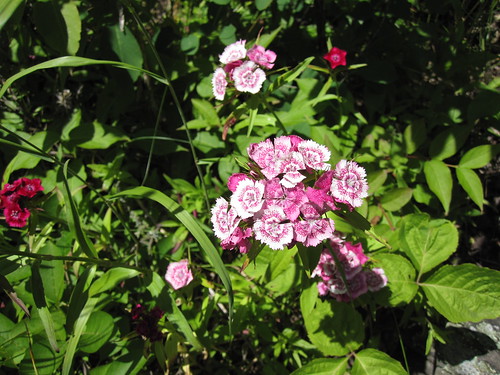
"Sweet William, Mary Hansen muses in Sawbill: History and Tales, "sometimes the only remnant of an old homestead."
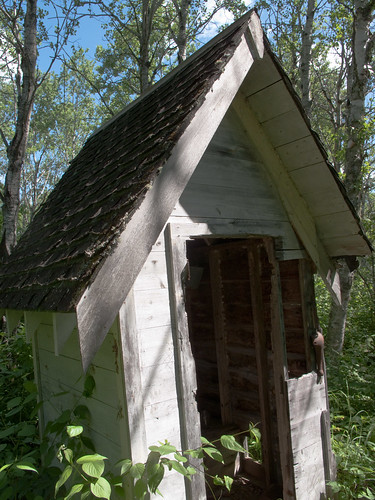
I neared the summit of Kelso Mountain and encountered a rock outcrop with a large splash of Sweet William. This old fire tower site contain other reminders of human habitation: a bear-clawed outhouse, deteriorating cans, an oil barrel mostly hidden in the brush. Probably, the brush leafed out with summer foliage hid even more from my view. Many scraps of civilization this in Canoe Wilderness, but none so beautiful as the flowers. Luckily I visited the site during the blooming season of Sweet Williams.
Rangers burnt the Lookout Tender's cabin to aid return to wilderness but after 50 years the flowers continue to bloom.
During a quiet time sitting among the flowers, I imagined the summer life of Vivian Johnson, who by day watched for smoke from the tower, and by night slept in the small cabin at its foot.
Friday, July 10, 2009
Pot Bellied Stallions

Like a tune you can't stop humming, some phrases you just keep remembering. You like the creativity, the play on words, the outrageous image it paints in your imagination. In addition it may summarize a current battle in your life.
Among such a 'signs to remember' I add that announcing a street dance on First Street in Duluth this evening: "First Street Street Dance featuring the Pot Bellied Stallions". Delightful name "the Pot Bellied Stallions." Googling the internet brings up their web site.
Rumor has it the gentlemen will play shirtless! Not to be missed gals .... (Really? No, just my imagination playing with their title!!!)
Thursday, July 09, 2009
Highway Memorial
 I present another in the series of curious roadside attractions.
A road trip through the Superior National Forest brought me to this unusual roadside memorial. I found it along Forest Highway 7.
The 'memorial' stands close by an abandoned tavern and other building. near Slate Lake. The 'memorial' consists of an authentic old  outhouse with a couple of stuffed dummies. She has a beautiful large glove and a yellow hat. He sports blaze orange socks. The old Christmas Wreaths add a festive, creative touch.
Winter in July

I found myself in Winter, MN on the Fourth of July.
Googling "Winter, MN" will show you its real and point to it on a map.
My GPS unit alerted me of Winter's approach as I barreled down the Stoney River Road in the Superior National Forest. The Stoney River Road lies atop the old DM and IR right-of-way to Forest Center.
Nothing seems to remain of Winter. My gps unit pinpointed the location of Winter between two banks where the old right-of-way cut through a sm all hill.
A few miles down the road, in Whyte I discovered a large bog filled with wild Iris "Blue Flag Iris" "iris versicolor".
The flowers grew as far as the eye could see. It is impossible to capture that picture in a photograph.
Sunday, March 08, 2009
Elys Peak Climbers Parking Area and Trail
Another way to access the Ely Peaks Area in the Short line Park area of Duluth.

A few years back a trail led from the Munger trail up the hillside to the tunnel once used by the Duluth Winnipeg and to get around Elys Peak. I found the trail scruffy, It required crossing the active railroad tracks of the DM&IR and trudging up a packed red-clay trail – slippery when wet – to reach the DW&P right-of-way. The trail initially cut across a private field
The land changed hands and the new owners closed the trail. The new Superior Hiking Trail provides more direct access to the summit of Elys Peak, but this new trail would provide a direct way to the old tunnel and base of the climbing wall.
From here another interesting trail can be used to gain the top of Elys peak. It runs beside the tiny stream up the valley which you can see between ‘Elys’ and ‘Peak’ on the map.
You will find the parking area and trail head just on Becks Road, just north of the bridge over the railroad tracks. Some rugged, beautiful country lies just above the old DW&P right-of-way: rock ledges and a pine forest.
Thanks to the volunteers who built the trail.
Friday, January 23, 2009
Retirement Saga – Step #2

My 65th birthday neared. A retirement workshop in the summer of 2007 helped me prepare. I learned that I must sig nup for Medicare when I turned 65. The presenter advised us to sign up a couple months before my birthday.
So in November, I stuck my toe into the bureaucratic waters of retirement. I called our local Social Security Office and scheduled the telephone application interview.
I cleared my calendar for the 1:40 pm call. My cell phone vibrated to life, then played my ring tone. A female voice verified my identity then asked, “Well, what can I do for you, Honey?”
Uff Dah! In a sudden flash my middle age fell away and senior citizenship arrived.
We don’t ‘Honey’ each other in Minnesota so I asked the woman if 
Relief, I spoke with a solid Midwestern Iowan not a gracious, honey-voiced southerner!
The English language has long since lost different forms of address based on social intimacy. The Germans have ‘Du’ for my brother, and ‘Sie’ for my boss. We Americans barely retain the formal Mr Smith for a stranger and the inform first name for a friend. We do however, "Honey” our elders.
I have Medicare Part A now. I obtained a letter from my employer saying my prescription coverage equaled or exceed that offered by Medicare. I received wallet sized cards and documents with my Social Security Number splashed all over them, enough to make an Identity Thief chuckle with glee.
So now I’m ready for Retirement: Step 3.
The pictures come from the Annual Spring Hike my brother and I take each year.Friday, January 16, 2009
A Winter Blast
Finally, after a week this cold weather is warming; the wind-chills are decreasing.
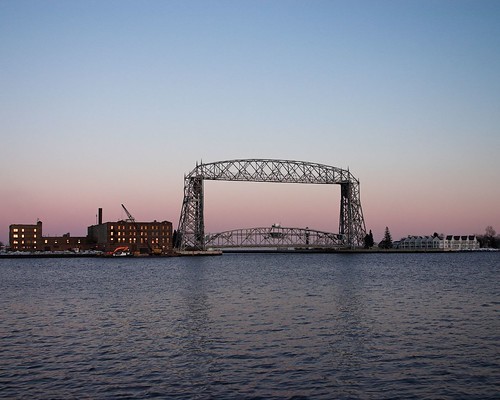
This frigid artic air swept in clean and clear. I made a couple photographs of the Aerial Lift Bridge yesterday and noticed how crisp distant objects seemed. We have the coldest weather in five years.

City | Jan 13 | Jan14 |
Duluth | -24 | -18 |
Intl Falls | -42 | -42 |
Embarrass | -44 | -47 |
My photographs show broken harbor ice. The Coast Guard has broken the ice in anticipation. We still expect two ships before this season ends and the Lake and harbor freeze. The Duluth News Tribune reports, “The Edwin H. Gott and the Edgar B. Speer were expected, but ice has slowed them down. They are through the Soo Locks and should be out on Lake Superior by now.”
When they arrive, winter will be official.
Saturday, January 10, 2009
Back on the Trail

I finally made my first venture out on the cross country ski trail yesterday evening. I skied the lighted Pine Valley Ski trail by night. It was beautiful. The temperature hovered at 15° F. A moon waxing toward a full moon filled the landscape with light.
I went two times around the 2 ½ km. loop.
The holiday season provided little time for skiing, besides the two dogs love running on the golf course, so I used my snowshoes for exercise.

I skied the longer 5 km loop this afternoon under a wonderfully sunny sky. The trail was well groomed and in excellent condition. A green wax for 5-15° F. worked very well.
Alas I think Maggie and Lila will mourn my return to skiing. (Dog are not allowed on the trail.)
Sunday, January 04, 2009
Snowed Off the Sidewalks
Two things mark this new year of 2009.


Fortunately, snowmobiles have packed down some trails which Lila, my dog, I can use to keep us off the street.
My son passed the diving test on the last day of 2008, December 31st. Now he has his Driver’s License and is ‘on the street’ for a different reason. That event is a milestone of freedom for every young person.
This morning I slept in. I grabbed my snowshoes and took Lila for a walk just at dusk. A quarter moon in a clear sky illuminated the new snowshoe trail I set through the swamp. After a short walk the biting winds forced me home. The temperature started its plunge to -20 F tonight. Winter certainly marks the beginning of 2009.
Friday, January 02, 2009
Siskins and Chickadees
Two types of birds frequent my feeders this winter: Pine Siskins
The Siskins visit the feeders in a mob. However Siskin culture seems to allow only one bird per perch. Incoming birds try to force the current occupant away. Siskins eat with a lot of waste. I am unsure whether they 
Chickadees swoop in take a seed and fly away to eat it in private. Often I see Chickadees ‘cleaning’ their beaks by rubbing each side on the branch where they are perched. Pine Siskins either have no such need or no manner compelling them to wipe their mouths clean after eating.

The birds who visit my feeders vary from year to year. A couple of years ago I had lots of these Purple Finches.
The first picture shows a couple of Pine Siskins. Picture #2 shows a female Purple Finch (I believe. The last picture shows a male Purple Finch.